
Increase capacity with the therapists you already have.
Patients keep working between visits, with their phone camera correcting each rep as it happens. Your therapists see exactly what was done, so they can decide which visits can move home and spend clinic time where it counts. No video leaves the phone.
The gap
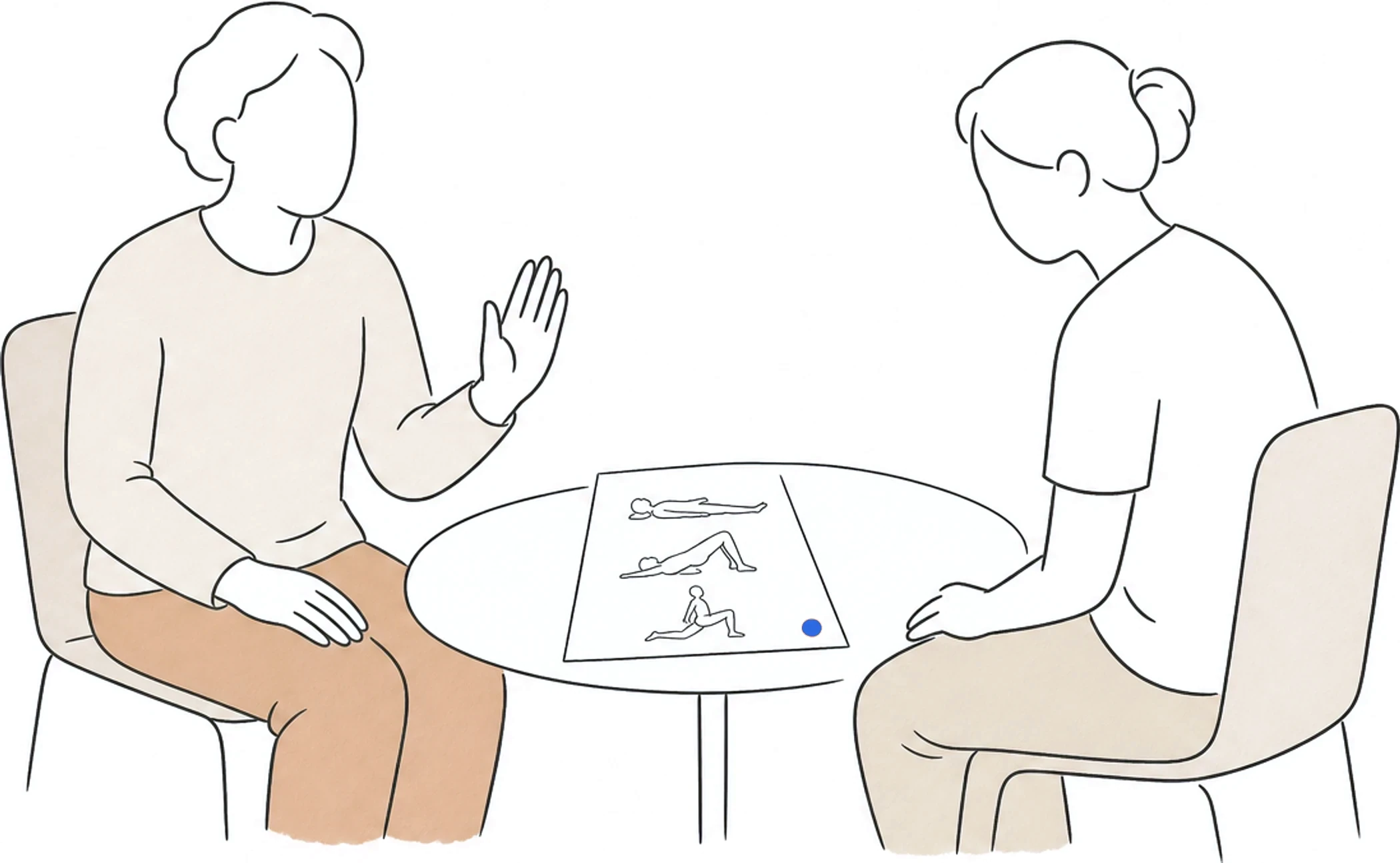
Ask the patient how much of their home program they did. Then ask their therapist.
You get two very different answers about the exact same weeks of treatment. How often to bring them in, when to progress them, what to bill for watching them. All three rest on the first answer, and nobody measured it.
“I did my exercises.”
Actually got done.
In the same study, only 15% of patients could accurately recall and demonstrate the exercises they had been prescribed. That is not a disagreement about effort. It is a patient tapping “done” on something they could no longer perform.
And a session that did happen still tells you nothing about how it went. “Done” carries no depth, no control, no compensation. A patient can work through the whole program badly for six weeks and neither of you finds out until they are back on your table. The gap is not only that patients do less than they say. It is that recovery at home is unsupervised.
Seeing patients more often is not the answer either. Most therapists have no room left in the schedule.
of therapists are at or beyond local capacity
average wait where they cannot meet demand
APTA Supply and Demand Forecast 2022–2037, published March 2025. The forecast
Peek K, Carey M, Mackenzie L, Sanson-Fisher R. Patient adherence to an exercise program for chronic low back pain measured by patient-report, physiotherapist-perception and observational data. Physiotherapy Theory and Practice. 2019;35(12):1304–1313. Cross-sectional study of 61 patients with chronic low back pain across six practices. PMID 29771180 · What this does and doesn’t prove
Between visits
A therapist in the room, for the sessions you are not in.
Between visits the patient is alone with a sheet of exercises and no way to tell whether they are doing them right. What goes in that gap is not a grade they read afterwards and not a call you had to be on. It is a correction, while the rep is still happening.
You set the tolerance once, at prescription.
How close to the ideal movement a patient has to get is your call, set per patient and per exercise: tighter for the knee at week ten, looser for the shoulder that will not get there yet. You review what comes back and change the plan when it needs changing.
The phone corrects the rep while the rep is happening.
The camera tracks the working joint and compares the angle against the tolerance you set. When it falls outside, the patient hears and feels it mid-rep, not afterwards and not as a score. The rep still counts either way: a shallow rep is a rep that scored badly, not one that disappeared.
The patient gets coached without anyone on a call.
No scheduled call, no live supervision, nothing sitting in a queue waiting for a therapist to look at it before the patient gets an answer. The loop closes on the handset: camera, joint angle, correction, next rep.
None of this puts a therapist on a call, so it adds no appointments to the day. The time you do spend is reviewing what came back and adjusting the plan, and that is the time remote therapeutic monitoring exists to pay for.
Which changes what a visit is for.
Some visits can move home, because you can see the work getting done there. The ones that stay in the clinic go to what needs a room and a pair of hands: manual work, the higher-acuity patient, the progression you can only judge in person.
How a rep is measured →The patient gets coached. The therapist gets the summary.
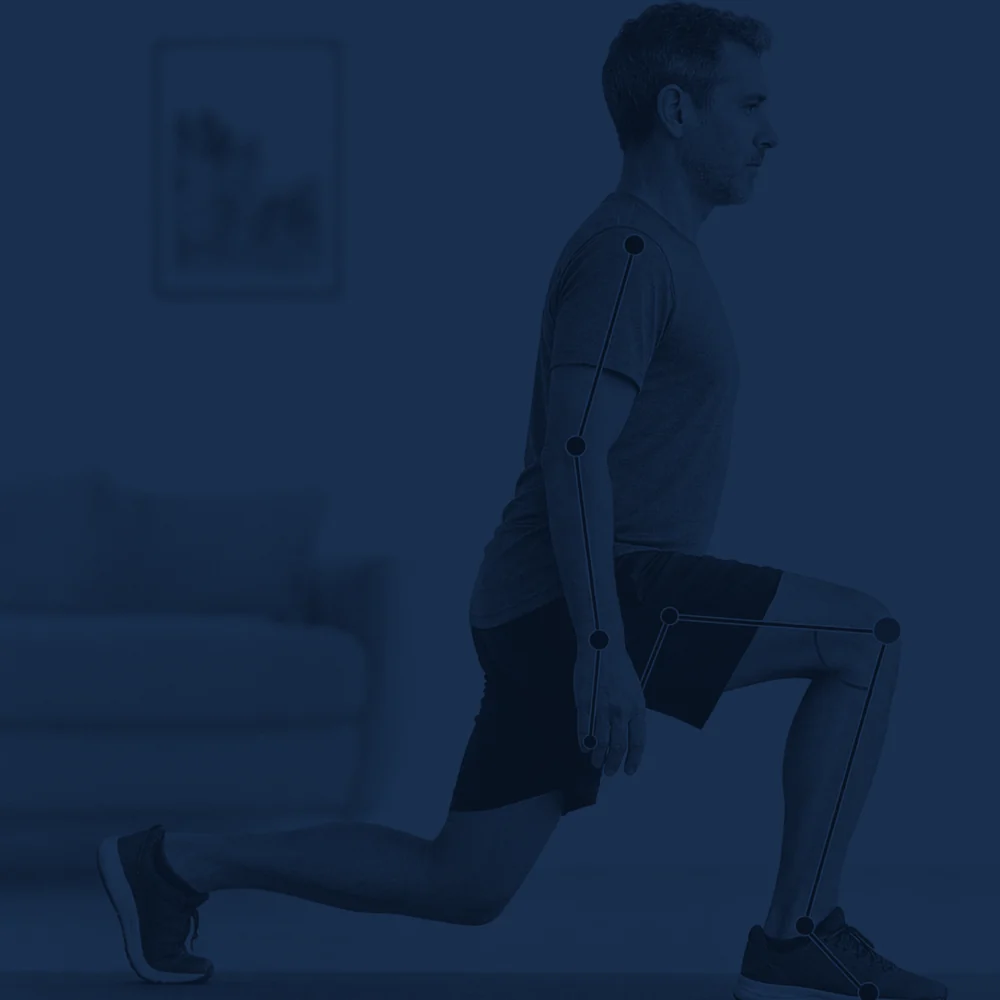
Each rep is corrected in the moment, within the limits you set for that patient. Your therapist gets a summary, not hours of video to watch, so reviewing it fits into the day.
- 186.6°Full depth
- 288.2°
- 392.4°
Rep three came up short — and the patient was told while they could still do something about it. The therapist just sees this.
The patient gets corrected. You get the record.
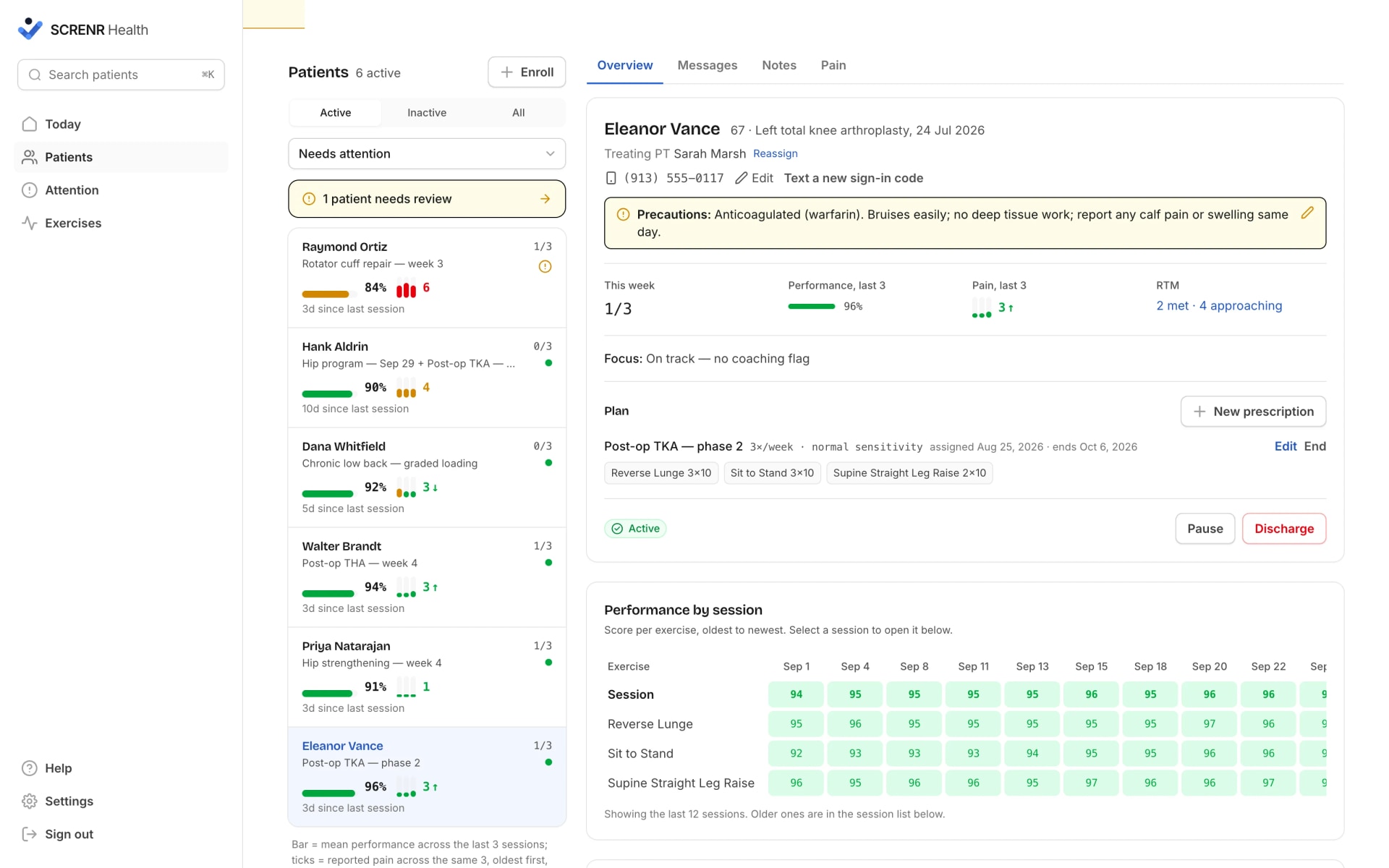
The same session produces both. During the set the patient gets the count and the correction; afterwards they get what the movement actually looked like. Nothing on their screen asks them to self-report, so nothing in your portal came from a tap.
 During
The camera view with the skeleton tracked onto the patient, the rep count legible from across the room because the phone is propped six feet away, and the knee angle being read live. That angle is what the correction comes off.
 After each exercise
Reps counted and how many reached the target depth, then one thing to change next time. It also says what the camera could not see, because not being able to see a rep is not the same as the patient skipping it.
Why the record holds up
Measured movement, not a checkbox.
Spreading a plan of care over a longer timeline only works if you know the work is still happening. Most home-exercise apps log adherence when the patient marks an exercise complete. That is a self-report, and it looks the same whether or not anything happened.
SCRENR derives the record from pose estimation running on the patient’s phone. What your therapist reads is observed movement: per-rep range of motion, timestamps, form status. That is why spacing out visits can be a clinical decision rather than a guess, and why the monitoring days hold up if anyone asks. And the footage goes nowhere. Pose estimation runs on the device; only the derived record syncs, never video. That is both the privacy position and the reason a session still works on a bad connection.
Clinic economics
Increase revenue and capacity with the team you have.
Five ways it pays, biggest first. Most of the value is capacity, not billing, and capacity only counts when the freed hours go to visits you would have booked anyway.
- 61%
Optimize visit mix
Low-acuity visits move home. The freed clinic hours go to the visits that need the room: hands-on and higher-acuity care, re-evaluations, and new evals.
- 14%
Activate RTM
Reimbursement for monitoring, on a record built from movement, not a tap.
- 14%
Recapture lost visits
Patients who would have dropped out stay in the plan of care.
- 3%
Extend therapy
Recovery continues past the plan of care, on a cash basis.
- 3%
Fewer no-shows
Fewer empty slots in the week.
Shares are modelled at a five-therapist clinic. The capacity figure does not assume every freed hour becomes a new evaluation. The model splits them across evaluations, re-evaluations, higher-acuity visits and admin, and then discounts the total for scheduling friction. Run it against your clinic.
Remote therapeutic monitoring is one of those levers, not the product. The seven codes, the two clocks they run on and the 2026 rates are set out in full on what RTM is worth in your clinic.
Who this is for
Built for
- Outpatient physical therapy clinics running 2 to 15 therapists
- Practices already aware of RTM but not billing it, or billing it nervously
- Owners who want adherence data they would be comfortable handing an auditor
- Clinics whose patients are on iPhones and whose plans are exercise-based
Not built for
- Employers or payers buying a digital MSK benefit for a population
- Health systems needing deep EMR integration on day one
- Clinics wanting a tool that treats patients without a therapist involved
- Practices looking for the cheapest possible HEP delivery
Questions we get
How is this different from the HEP app we already have?
Your current app almost certainly logs adherence when the patient marks an exercise complete. That is a self-attestation, and it tells you nothing about how the movement went. SCRENR analyzes the movement itself, joint angles frame by frame on the phone. That is what lets it correct the patient during the set, and why the monitoring record is more than a tap.
How much extra work is this for my therapists?
Prescribing the program and setting the tolerance, once. No calls to attend while the patient exercises: the phone coaches each rep. Your therapists review what came back, follow up, and change the plan when it needs it, which is the same time the management codes reimburse.
What happens if the camera gets a rep wrong?
Sometimes it will, which is why we publish an accuracy standard rather than claiming perfection. The record is per rep and shows the angle each one reached, so a count that looks wrong can be checked rather than taken on faith. We count generously and score honestly, so when the camera gets it wrong you see a rep that scored badly, not one that disappeared.
Is this billing advice?
No. We build the data layer and the portal view that makes RTM documentation defensible, and we show you the arithmetic. Code selection, medical necessity, and claim submission stay with your clinic and your biller.
What does onboarding actually involve?
A strategy call first, to see whether your caseload and payer mix make RTM worth billing at all. If it does, we scope a pilot against a defined patient cohort with agreed success criteria before anything goes clinic-wide.
Find out what hybrid care would mean for your clinic.
Twenty minutes. We look at your caseload and payer mix, where hybrid care would free up therapist time, whether remote therapeutic monitoring (RTM) is worth billing, and how your current adherence data would hold up if someone asked you to defend it. If the numbers do not work for your practice, we will tell you that on the call.
On the call we cover
- Whether your patient mix clears the monitoring thresholds
- What your current adherence record would survive
- Conservative revenue math against your own numbers
- What a scoped pilot would involve